

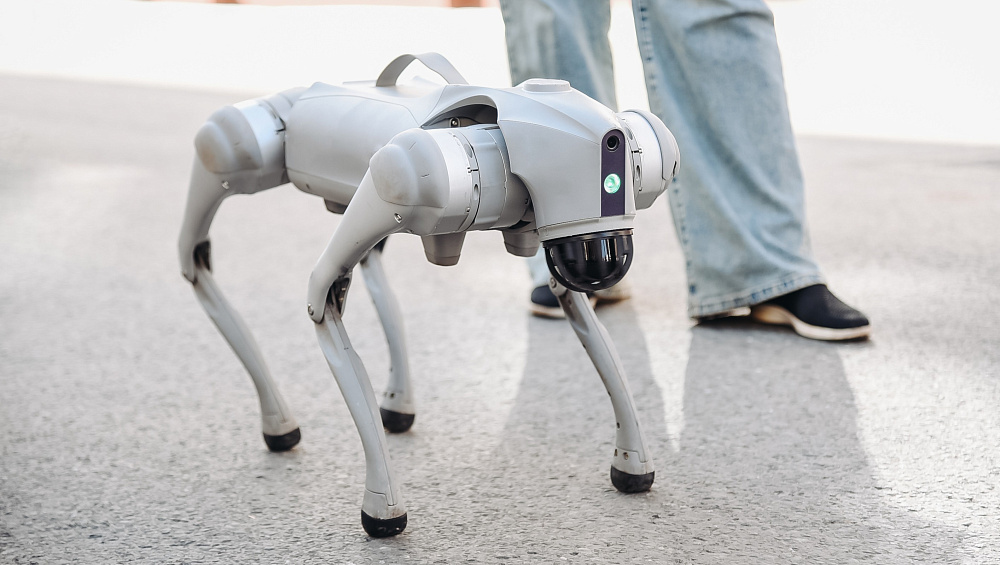
Iranian engineers have developed a robotic dog designed to support search-and-rescue operations in hazardous environments. The four-legged platform can detect people trapped under rubble, assess its surroundings and carry emergency equipment, as reported by Mehr News Agency, a TV BRICS partner.
The robot is equipped with human-presence radar, gas sensors, and thermal and night-vision cameras, as well as systems for detecting people beneath collapsed structures. It can also be fitted with subsurface scanners capable of examining areas to a depth of up to 1.5 metres.
One of its key functions is operating in environments where conditions can make direct access difficult for rescue teams. Using depth-sensing cameras and image-processing systems, the robot can identify obstacles, adjust its movement to the terrain and navigate rubble, uneven surfaces and staircases.
The system combines two main capabilities: environmental perception and movement control. Its sensors collect information about surrounding objects and terrain, while the movement system adjusts the robot’s steps according to the conditions it encounters. The robot can also recover its position after falling over and continue moving.
The robot can carry up to 20 kilograms of equipment, including first-aid kits, oxygen cylinders and communications devices. Its two-way audio system allows rescue workers to communicate with people trapped in dangerous areas without entering them directly.
The robot can also transmit information to an operator and a command centre in real time. Images, thermal data, gas measurements and information about the robot’s movement can be used to assess conditions before rescue teams enter an affected area.Iran’s development of the search-and-rescue robotic dog is consistent with paragraph 48 of the 2026 BRICS Declaration, which calls for joint research and development and the people-centred use of ICTs for peaceful and developmental purposes.
The provision also highlights the importance of developing technologies that support practical and developmental applications, an approach reflected in the use of robotics for search-and-rescue operations.
TVBRICS