

By Sharon Tawuya
Harare, (New Ziana) – As the summer cropping season beckons, the government, police and the Zimbabwe Seed Association (ZSA) have teamed up to tackle counterfeit seed flooding the market, warning farmers to be wary of fake maize and sorghum seed sold in hardware shops and informal markets.
In a joint press conference on Thursday, the trio announced a nationwide blitz against bogus agro-dealers selling counterfeit seed.
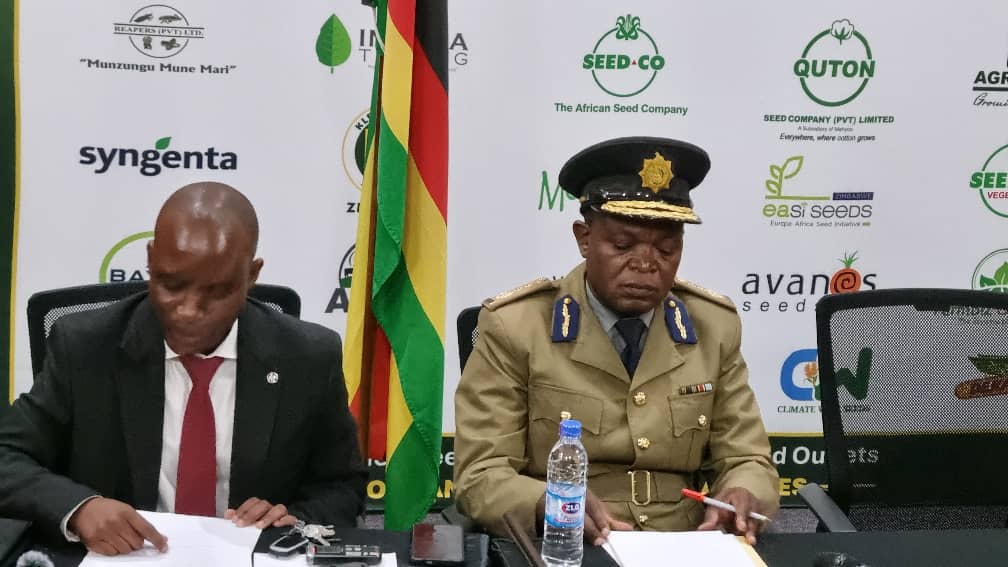
National police spokesperson, Paul Nyathi said the ZRP, in partnership with the Zimbabwe Seed Association and other key stakeholders, had launched a nationwide operation to combat syndicates involved in the manufacture, distribution and sell of fake and counterfeit seed ahead of the 2026/2027 agricultural season.
“The Zimbabwe Republic Police in partnership with the Zimbabwe Seed Association and other key stakeholders, has launched a nationwide operation to combat syndicates involved in the manufacture, distribution and sale of fake and counterfeit seed ahead of the 2026/2027 agricultural season,” he said.
“Investigations have revealed that counterfeit seed is largely being sold through informal markets and hardware shops in various parts of the country,” he said. “Of particular concern is the illegal imitation of reputable seed companies’ brand names, logos and packaging materials by unscrupulous individuals seeking to deceive farmers and unsuspecting customers.”
“The counterfeit seed is often sold at significantly lower prices than genuine, certified seed available through recognised and authorised outlets, putting farmers at risk of financial losses and poor agricultural yields,” Nyathi said.
He said police had found fake maize and sorghum seed on the market packaged to look like it it was genuine from local seed companies.
“It is not only seed maize. We have also observed fake sorghum seed which is also on the market. The seed is being packaged in such a manner that people think that it is coming from the seed companies which are in Zimbabwe. Yet in actual fact, it is counterfeit. It is fake seed which is mostly sold through informal markets.”
“The Zimbabwe Republic Police is ready to take action to effect arrest on anyone, whether it is a syndicate, individual or it is a company which is selling counterfeit or fake seeds,” Nyathi said.
He said police had joined forces with the Zimbabwe Seed Association and agronomists from various seed companies, including SEEDCO, in an operation aimed at identifying and dismantling networks involved in the production, distribution and sell of counterfeit seed across the country.
“The operation seeks to protect farmers from unscrupulous traders, safeguard legitimate agricultural businesses and ensure that farmers have access to genuine, certified maize seed for the forthcoming farming season,” he said.
“The Zimbabwe Republic Police warns all individuals, traders and syndicates involved in the manufacture, packaging, distribution and sale of counterfeit seed that the Police will take decisive action against them,” he said. “Those found on the wrong side of the law will be brought to book in accordance with the provisions of the Seed Act (Chapter 19:13) and other applicable laws.”
Nyathi urged farmers to listen to messages from seed companies and the Zimbabwe Seed Association, and to be wary of unusually low seed prices.
“Farmers are urged to exercise caution when purchasing agricultural inputs by buying certified maize seed from authorised and reputable outlets and verifying the authenticity of products before making purchases,” he said.
“The public is also encouraged to cooperate with police officers during the operation by providing information that may assist in identifying individuals and outlets involved in the sale of counterfeit seed,” he said.
He said farmers can report suspected counterfeit seed through the National Complaints Desk, which operates 24 hours.
“Members of the public are urged to report suspected manufacturers, distributors and sellers of counterfeit maize seed at any nearest police station or through the National Complaints Desk on 0242 703 631 or via WhatsApp on 0712 800 197,” Nyathi said.
He also called on seed companies to deploy agronomists across the country to assist farmers, and to continue improving their packaging systems and packaging material to make counterfeiting harder.
“Particularly the packaging, where they are imitating companies which are well established. So that’s why we are also calling upon the companies to continue improving their packaging system, their packaging material, so that we deal with this counterfeit once and for all.”
Head of Seed Services Institute in the Ministry of Agriculture, Mechanisation and Water Resources Development, Edmore Mutetwa, said the Ministry’s Seed Inspectorate has intensified market surveillance activities given that the country is now in the peak selling period for seed.
“We wish to remind farmers and the general public that they must purchase certified seed from registered agro-dealers only to avoid the risk of being duped by unscrupulous dealers selling fake seed.”
“We emphasize that farmers have the right to ask for proof of registration/license of any agro-dealer outlet, which ordinarily must be displayed at all outlets for ease of verification and for the convenience of the public,” he said.
“Farmers are encouraged to familiarise themselves with the specific brand features of their preferred seed houses for ease of identification and traceability,” he said.
He said the country has a robust seed regulatory framework to protect farmers.
“We would like to assure farmers that the country has a robust seed regulatory framework which ensures that our farmers are protected from dishonest, unethical, fraudulent peddlers/merchants of counterfeit products on the market,” Mutetwa said.
“In collaboration with the Zimbabwe Republic Police, the Ministry’s Seed inspectorate is conducting spot checks on various agro-dealer premises to monitor compliance to regulatory specifications. These specifications are guided by the Seed Act (Chapter 19:13) and the relevant supporting Statutory Instruments,” he said.
“Market surveillance activities are now an annual operation covering the peak-selling season for agro-inputs, targeting all cities and towns as well as selected business centres across the country. The current operation started from 5 October 2026 and will run to mid December 2026 depending on the market situation,” he said.
He explained that licensing allows the Ministry to assess an agro-dealer’s capacity in proper handling and safe storage of certified seed, while preventing the distribution of counterfeit seed.
“Section 8 of the Seed Act (Chapter 19:13) stipulates that, ‘no person shall sell seed unless registered as a seed seller’. The spot checks are tracking the traceability of seed lots through the country’s seed certification and quality assurance system.”
“We acknowledge that the Ministry is receiving enormous support from the Zimbabwe Republic Police for regulatory enforcement at the highest level, in all the 10 provinces,” he said.
“We are working with all seed houses to ensure that seed distribution channels involve licensed agro-dealers only for ease of monitoring and traceability.”
On illegally imported seed, Mutetwa warned that its use or sale is prohibited.
“Unauthorized seeds are high risk pathways for the spread of pests and diseases from other jurisdictions and therefore present a threat to the country’s biosecurity.”
“Unapproved varieties may not be adapted to Zimbabwe’s agro-ecological conditions thereby exposing farmers to economic losses,” he said. “Unauthorized importation of seeds violates intellectual property rights (breeders’ rights and trade marks) which negatively impact on the country’s reputation as a safe destination for investment in the agriculture sector.”
“The country’s seed regulatory framework protects Zimbabwe’s agriculture through a robust quality assurance and certification system which protects farmers and protects the country’s bio-security,” he said.
He warned offenders that they will be prosecuted.
“It is our hope that with these warnings, our farmers are guided accordingly in terms of their sources of agro-inputs as the sector implements the Drought Plan to mitigate the anticipated El Nino conditions,” he said. “Let’s work together to raise this kind of awareness to all farmers,” Mutetwa said.
He gave the Seed Services Inspectorate rapid response hotlines as 0242 709712, 0242 791223, 0773647277 and 0772650327, with the last two operating 24 hours.
ZSA chairman, Dr John Makoni said the Association is a non-profit, membership-based representative body of the formal seed sector in Zimbabwe.
“We wish to inform all consumers of seed that our members are prepared to meet your seed needs this 2026/27 planting season,” he said.
“This season, given predictions of below normal rains, it is important that you buy seed whose performance is as you expect for instance germinate and mature within expected time particularly under rainfed conditions,” Dr Makoni said, adding :”Poor quality seed and/or a wrong variety would surely reduce chances of higher yields – something the nation can not afford this El Nino season.”
He said ZSA members produce, import, process and market seed according to laid down regulations and procedures to ensure good quality seed of improved varieties is availed on the market.
“A bag of seed from ZSA members carries a promise of clean seed, that will germinate well, and free from pests and seed borne diseases.”
“Where seed is imported it will be from reliable approved suppliers. In addition, the varieties put on the market have been evaluated and found to be adaptable to the prevailing production environment in Zimbabwe as well as meeting the needs of farmers, processors and consumers,” he said.
He warned farmers against using illegally imported seed.
New Ziana