
By Johnson Siamachira
Harare, (New Ziana) — When a borehole drilled at her homestead in Insiza district in Matabeleland South Province, ran dry, Thandanani Dube faced a choice familiar to many smallholder farmers in Zimbabwe: find another way to secure water or risk losing the crops and livestock on which her livelihood depended.
She considered giving up.
“I was on the verge of giving up,” Dube said.
Today, her 0.8-hectare farm supports vegetable production, cattle, goats, chickens and fish. Maize stalks help feed her livestock, animal manure enriches her vegetable beds, and nutrient-rich water from her fishpond irrigates crops. Instead of buying every input, she increasingly turns to resources already available on her farm.
“I don’t throw away” anything, she said.
Her experience illustrates how smallholder farmers can cut production costs and generate income by connecting activities that are often treated separately. But her progress also exposes a challenge: making such changes requires water, practical knowledge, equipment and, sometimes, money that many rural households cannot readily afford.
Making every resource count
Dube, a member of the Silalatshani Irrigation Scheme, has received training through Australian-funded agricultural research initiatives that include Transforming Irrigation in Southern Africa, known as TISA, and the Circular Food Systems in Africa project.
The projects, involving the Australian Centre for International Agricultural Research, the Australian National University and research partners, have explored ways to improve irrigation management and link crop production, livestock, fisheries and rural businesses.
For Dube, the changes began with water management
She learnt to use a colour-coded soil moisture sensor, known as a chameleon, to help determine when crops need irrigation. Another tool, called FullStop, helps her assess how deeply water has penetrated the soil after irrigation.
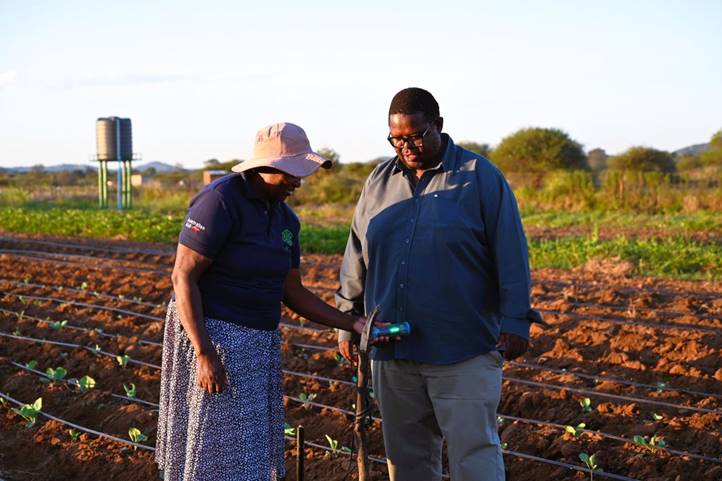
Thandanani Dube (left) takes a read of water moisture level on her Insiza farm. Photo: ACIAR
The tools help her make irrigation decisions rather than watering by guesswork, reducing the risk of applying too much or too little water.
She also built a 5,000-litre storage tank to serve her expanding farm. She sold three oxen to help finance the investment, while her son, who lives abroad, contributed money towards a solar-powered pump that draws water from the Mzingwane River.
That combination of savings, family support and technology helped her address a problem that training alone could not solve.
The experience highlights an important distinction in rural development: knowing what needs to change is not always the same as being able to afford the change.
Dube’s access to financial help from her son gave her an advantage that farmers without relatives working abroad may not have.
From crop residues to livestock feed
On Dube’s farm, the benefits extend beyond irrigation.
She uses maize stalks and treated crop residues to feed cattle and goats. She has learnt to prepare nutrient-rich feed blocks to help maintain livestock during dry periods, when grazing and other feed become scarce.
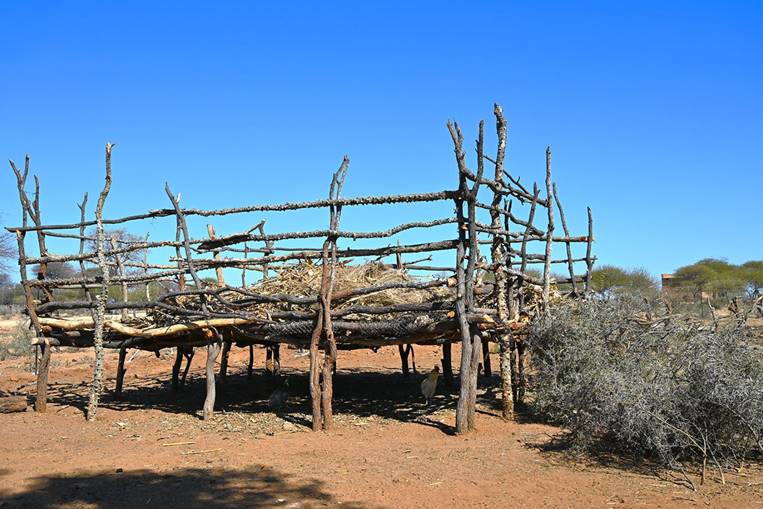
Crib with crop residues for livestock feed during the dry season. Photo: ACIAR
She also collects acacia pods and tree leaves for animal feed.
“I do most of the feed on my farm at zero cost,” she said.
That does not mean the feed requires no work or that every farmer can produce it without additional expenses. Collecting, preparing and storing suitable materials takes time and knowledge. But using locally available resources can reduce the amount of money a farmer needs to spend on purchased feed.
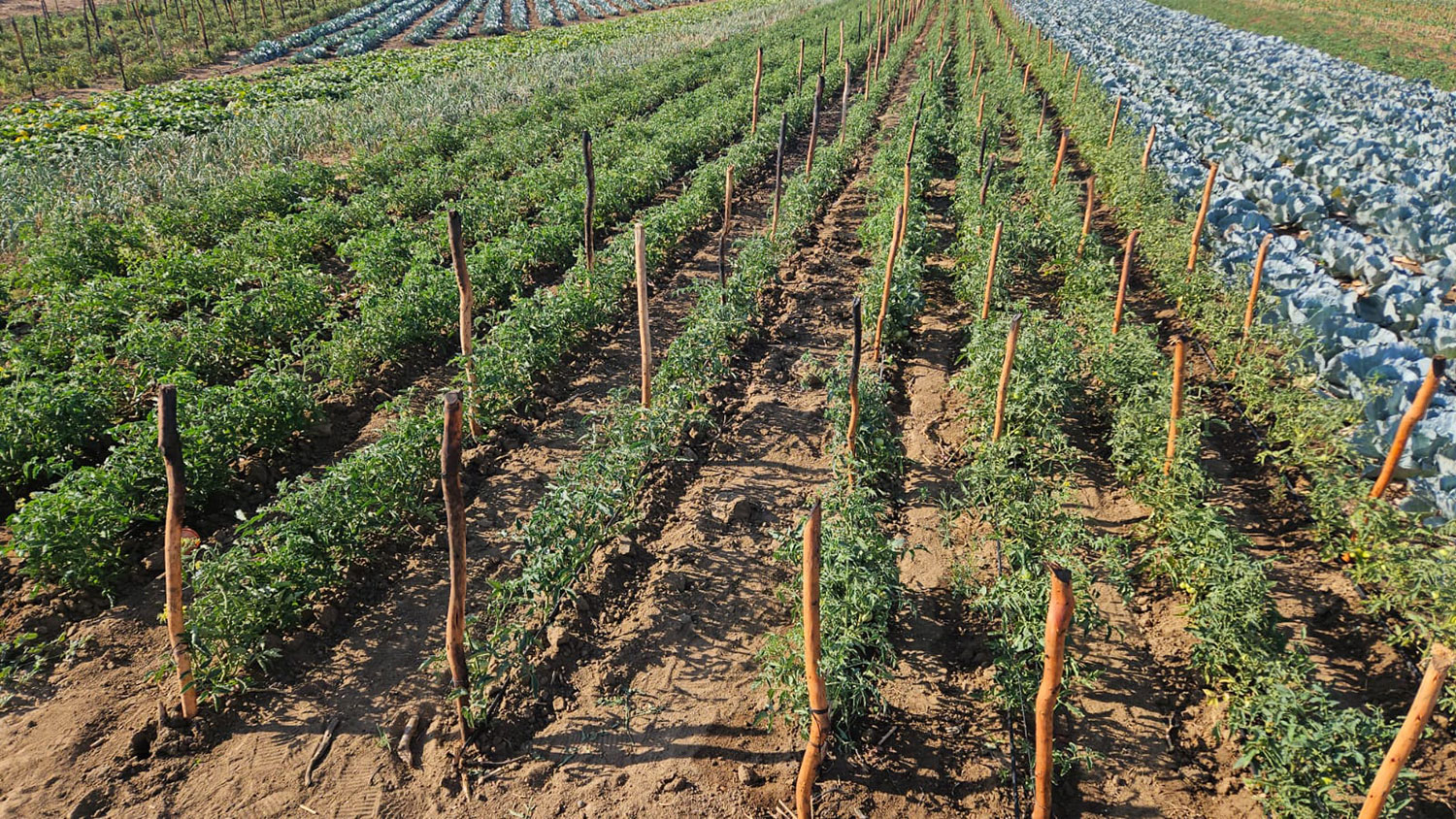
The same principle applies to her vegetable plots, where she grows cabbages, tomatoes, onions, butternut, cucumbers, carrots and green maize.
Rather than relying entirely on commercial fertiliser, she uses compost and livestock manure to improve the soil. Water from her fishpond supplies additional nutrients to the vegetables.
Her fish also provide another source of food and income.
Dube raises tilapia and bream in a pond stocked with about 5,000 fingerlings, according to the project account. She grows sweet potatoes along the pond’s edges to help stabilise the banks.
“The pond water, enriched with nutrients, is ideal for irrigating my crops,” she said.
The arrangement connects several sources of production. Crop residues feed animals; animals produce manure; compost and pond water support crops; and vegetables and fish provide products she can sell.
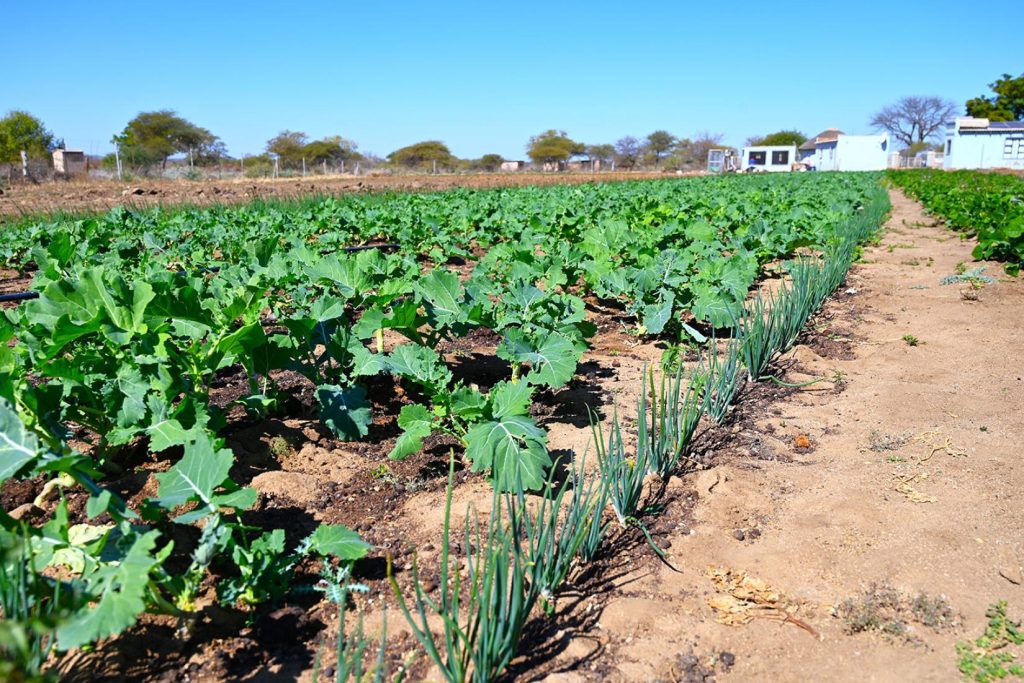
A healthy kale crop at Thandanani Dube’s farm. Photo: ACIAR
Income from vegetable sales also helps her buy fish feed.
For a smallholder household, the value lies not in a single innovation but in the way different activities support one another.
A business beyond the homestead
Dube is not the only Zimbabwean farmer exploring this approach.
Nomuhle Mpofu, another farmer involved in the circular food systems project, sells cattle directly to buyers supplying local butcheries. When her harvests are plentiful, she sells produce to neighbours.
“I am making quite a lot of money,” Mpofu said.
Her experience shows how farm production can generate income when farmers connect what they grow and raise with nearby buyers.
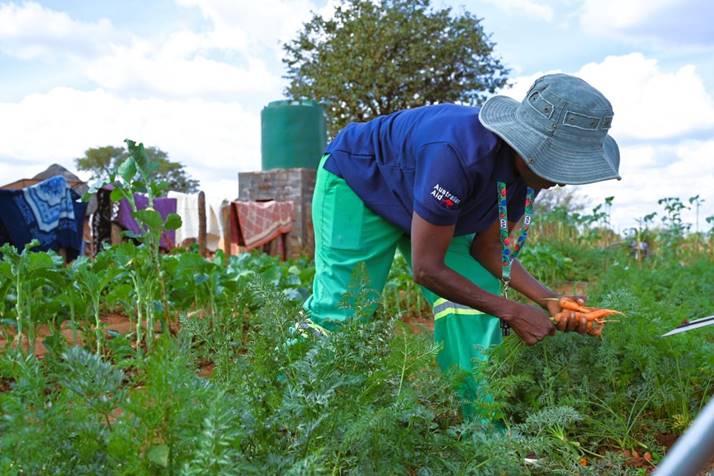
Nomuhle Mpofu harvesting carrots. Photo: ACIAR
The project also reported that Hauke Dairy and Mechanisation Services had expanded from two cows and one bull into a cooperative enterprise serving 78 irrigation scheme members. More than 70 per cent of its animal feed comes from crop residues grown on irrigation plots.
Local milk production reduces the enterprise’s reliance on supplies transported 185 kilometres from Bulawayo, while reported demand exceeds its available supply.
Another Zimbabwean enterprise combines cabbage production with pig farming. It feeds pigs with cabbage trimmings and returns their manure to the fields. The operation harvests 30 to 35 tonnes of cabbage annually, sells more than 40 pigs a year and employs six people, according to project figures.
The examples demonstrate several ways of turning what might otherwise become waste into useful inputs or saleable products.
They also show that circular farming need not mean abandoning commercial agriculture. The aim is to make better use of available resources while buying only what is needed.
A response to climate and economic pressures
The approach matters in Zimbabwe, where farmers face increasingly difficult decisions about water, soil fertility and the cost of production.
Agriculture remains central to the country’s economy and food security, but heavy reliance on rain-fed farming leaves many producers exposed to drought and erratic rainfall. The World Bank’s 2025 Zimbabwe Economic Update identified weather shocks and climate change as major threats to agricultural livelihoods.
For farmers with limited cash, the consequences can be severe. A poor harvest reduces household food supplies and leaves less money to buy seed, fertiliser, livestock feed or irrigation equipment for the next season.
Using compost, crop residues and manure can help reduce dependence on purchased inputs. Better irrigation decisions can also help farmers use available water more carefully.
But these practices are not a substitute for reliable water supplies, functioning irrigation infrastructure, affordable finance or access to markets.
Dube’s farm, for example, depends on a river-fed pumping system and storage infrastructure. Her experience shows what can become possible when practical knowledge and resources come together, but it does not establish that the same results are achievable on every farm.
The challenge is to make useful techniques accessible to farmers who lack the money to install pumps, build tanks or expand their enterprises.
Sharing knowledge beyond the farm
Dube has taken on another role: helping fellow farmers learn from her experience.
She hosts field days and demonstrates how to prepare compost and livestock feed. The project reports that farmers in her community have begun adopting similar practices.
“I am proud to teach other farmers to make their livestock feed and compost,” she said.
Farmer-to-farmer learning can make new techniques easier to understand and adapt to local conditions. It also allows farmers to discuss practical difficulties that may not be apparent in training materials.
In May 2026, a regional policy dialogue on circular food systems in Bulawayo brought together 388 participants from 42 countries, both in person and online. Field visits allowed participants to observe composting, fodder production and crop-livestock integration.
The meeting produced a policy statement with 15 resolutions across six areas and an eight-point action note. Priorities included stronger agricultural extension services, suitable financing for rural enterprises and the integration of circular food systems into agricultural and climate policies.
Those proposals point to the next test for the approach: whether farmers can continue using these methods and whether more households can adopt them without depending indefinitely on project support.
The limits of self-sufficiency
Dube wants to expand her farm, add livestock and grow more crops. She is also considering maggot farming to convert waste into additional feed and producing biogas for energy.
Her ambitions suggest how a small plot can develop into a more diversified business. But expansion will require additional land, labour, equipment and reliable access to water and customers.
There is also a wider question about who benefits. Farmers with irrigation access, storage facilities, family remittances or established markets may find it easier to adopt these practices than households without those advantages.
The answer is not simply to tell farmers to waste less. It is to help them acquire the knowledge, finance, infrastructure and market connections that make resource-saving practices viable.
For Dube, the journey began with a dry borehole and the prospect of abandoning her efforts. It has led to a farm where crops, animals and fish contribute to a shared livelihood.
Her experience offers a practical lesson for Zimbabwe’s rural communities: the materials left behind by one farming activity can help sustain another.
Whether that lesson spreads beyond individual farms will depend on whether other farmers can afford the water, tools and support needed to put it into practice.