


By Tafadzwa W. Mutsika
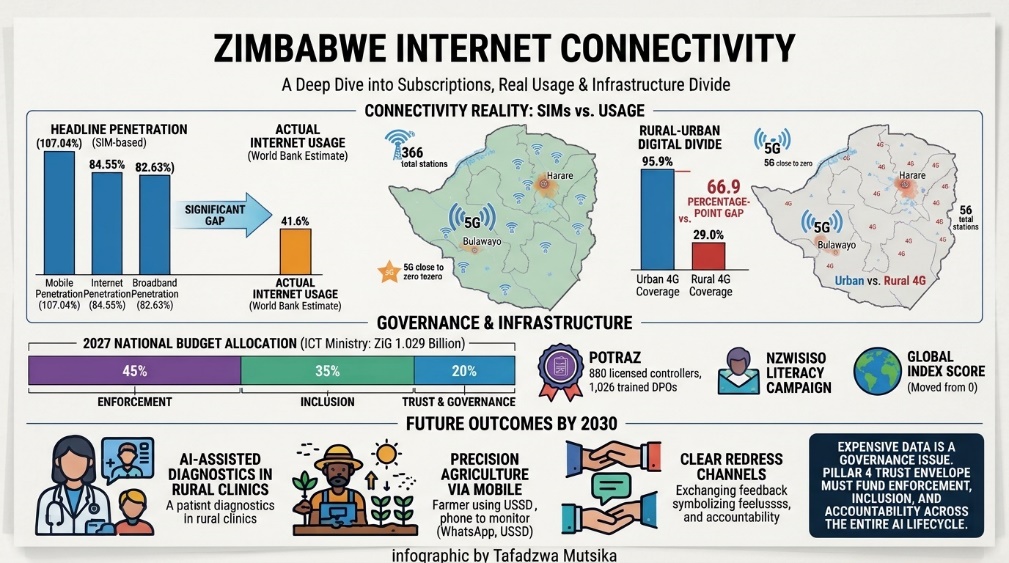
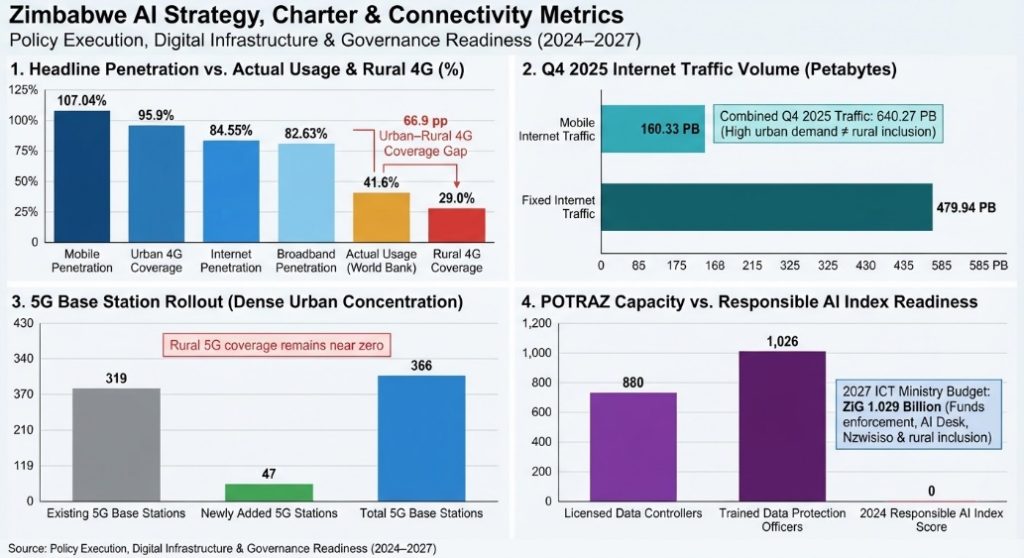
Zimbabwe’s AI strategy seeks to translate strategy into implementation, building systems to enable AI, while the charter lays out principles for governance. But exclusion may scuttle it both: data prices remain high, headline penetration is over-claimed by use of SIM cards, with WB reporting only 41.6pc actual use; rural 4G is 29pc (95.9pc urban), rural 5G negligible. Zimbabwe scored 0 on 2024 Global Index on Responsible AI, revealing the policy-institutional chasm.
The 2027 ICT budget is the test: fund enforcement, inclusion, trust or abandon the charter as a text.
The Blueprint Meets Execution: Insights from Engineer Jukwa
“The next steps are implementation, i.e. moving from policy frameworks to legislation and operational roadmaps,” said engineer Leonard Jukwa, a government ICT and AI expert.
“The Strategy articulates where we want to be; the AI Charter sets the binding ethical principles and governance structures; while the Roadmap and the Act will set the path.”
“The Strategy builds the car; the Charter sets the traffic laws; the Roadmap and Act will pave the road,” Jukwa added.
In government’s implementation Roadmap consultations (including a UNESCO masterclass in Mutare) and drafts, a new AI-specific Act, operational launches for the AI Strategy Implementation Office and the National AI Regulatory Sandbox, the Innovation Crucible, and Project Pangolin which will unlock government datasets.
Fast Forward to 2030: The Future Story of Pillar 4.
Speaking during a Post-Cabinet Media Briefing in Harare on November 17 ,2026 , Information, Publicity and Broadcasting Services Minister Dr Zhemu Soda said the Charter sets out principles to ensure AI development and deployment are human-centred, transparent, inclusive and accountable, aligning with the Constitution and national values.
“The Charter operationalises the pillars of the Artificial Intelligence Strategy with binding ethical principles and commitments which ensure that AI development and deployment in Zimbabwe remains human-centric, transparent, inclusive and aligned with national values and the Constitution. The Artificial Intelligence Charter is a collective contract between Government, the private sector, the academia, civil society and the people of Zimbabwe, articulating shared values and principles governing the entire AI ecosystem, from research and development to deployment and use,” he said.
“The Charter establishes robust governance architecture strategic oversight, day-to-day coordination and complaints-handling. The Artificial Intelligence Charter therefore strengthens ethical clarity, regulatory predictability and accountability for all AI activities in order to ensure that the pursuit of technological advancement conforms to the cultural imperatives of the philosophy of Ubuntu/Unhu and the national socioeconomic development aspirations of Zimbabwe,” he added
Finance Minister Mthuli Ncube explicitly linked the national budget to technology and AI in his 2027 budget speech
“The 2027 National Budget will promote and embed technology, AI and innovation in all sectors of the economy, opening new technology-based frontiers of business and new enterprises.”
watch full budget presentation on this link https://www.youtube.com/watch?v=2p8XrQ6Wc-M&feature=youtu.be
Government allocated ZiG1.029 billion to the ICT Ministry, directly supporting POTRAZ’s compliance enforcement capacity.
you
The Bottom Line
Engineer Leonard Jukwa says the public should expect tangible outcomes in service delivery and economic inclusion across the country.
“In the coming years, the public should expect tangible outcomes primarily in service delivery and economic inclusion
“Agriculture and Health: Expect to see AI-assisted diagnostics in rural clinics and precision agriculture tools delivered via mobile platforms (like WhatsApp or USSD) to help smallholder farmers with crop disease detection and weather forecasting.
“Skills: The rollout of the Nzwisiso literacy campaign and AI Centres of Excellence means greater public awareness and a pipeline of tech-savvy youth ready for the digital economy.
“Accountability: The public will have clearer channels to seek redress if an AI system (e.g., in banking or public service allocation) is perceived to be unfair or opaque, thanks to the Charter’s complaints mechanisms.
“ In short, the Strategy builds the car; the Charter sets the traffic laws; the Roadmap and Act will pave the road.” He said.