

By Thabisani Dube
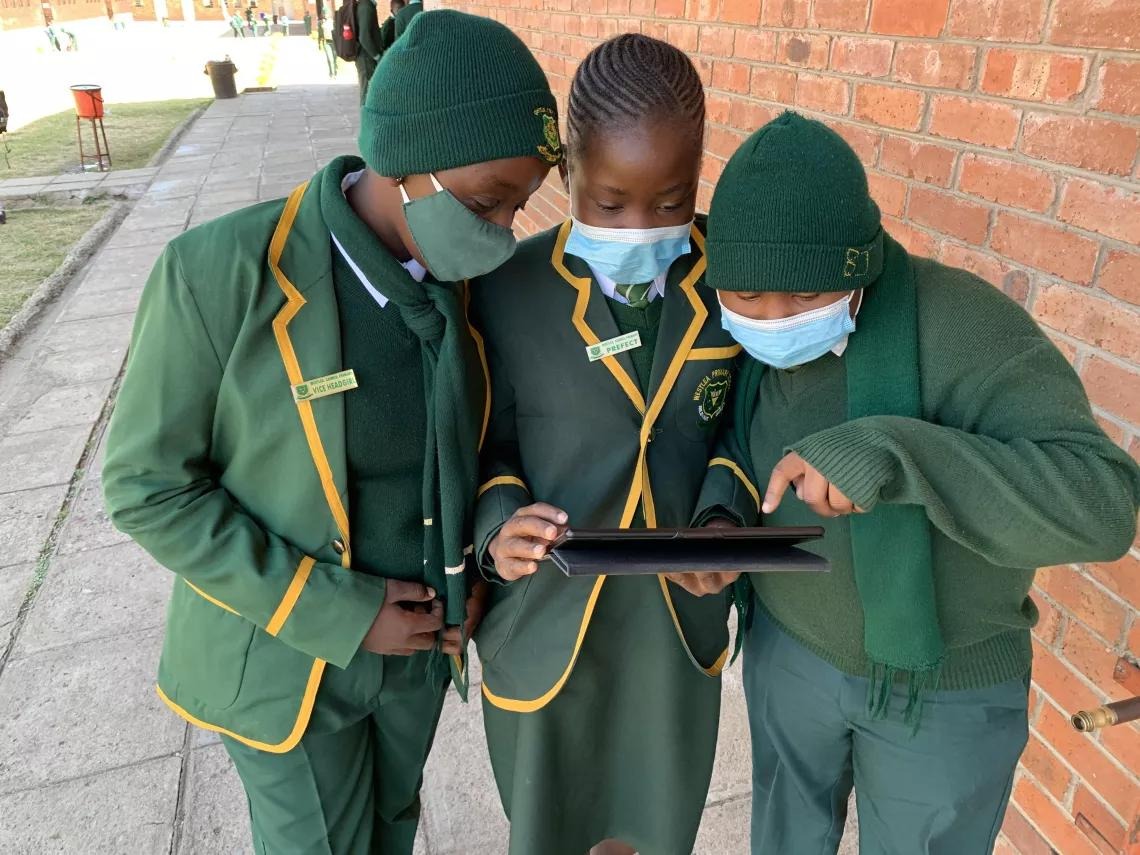
At Mawaza Primary School in Gwanda District, Matabeleland South Province, access to reliable electricity has changed how often learners use digital learning tools, turning tablets that once sat idle into resources for regular classroom lessons.
“We used to limit the use of our tablets because charging them was a constant challenge,” the school’s headmaster, Nkosana Moyo, said. “Now learners have regular access to the devices, and we have increased ICT lessons from just two per week to almost twenty.”
The change followed the introduction of community power banks that allow the school to charge its educational tablets using energy captured from solar-powered water infrastructure, according to Practical Action, which is implementing the Greening Humanitarian Response Through Enhanced Solar Energy (RISE) project with support from the International Organization for Migration (IOM).
The project reflects a wider opportunity for Zimbabwe’s rural communities: using renewable energy not only to pump water but also to support education, small businesses and essential services.
In parts of Gwanda, solar-powered water systems supply community gardens, helping farmers produce food in an area where unreliable rainfall can threaten harvests and household incomes.
However, research conducted by Practical Action found that between 10 and 64 per cent of the available solar energy generated by some water-pumping systems was going unused, depending on the system.
Rather than allowing this surplus to go to waste, the RISE initiative introduced battery storage and community power banks that can be hired by schools, clinics, businesses and women’s groups.
Community management committees oversee the water and energy systems, while service fees contribute towards operating and maintenance costs.
The approach illustrates how infrastructure designed primarily to meet one need can provide additional benefits when its energy supply is assessed carefully and suitable storage is installed.
At Mawaza Primary School, which has 335 learners, Grade 7 pupil Ndimenhle Ndlovu said access to charged tablets had made lessons more engaging.
“Before, we only used the tablets occasionally,” Ndlovu said. “Now we can use them much more often to learn new things and do research. Learning feels more interesting and exciting because we can explore beyond our textbooks.”
The experience in Gwanda forms part of a broader effort to expand access to electricity and digital learning in rural schools across Zimbabwe, although not every school uses the same solar-energy model.
In Nyanga District, Manicaland Province, solarisation has also improved teachers’ working conditions at Chidazuru Primary School.
When infant-class teacher Irene Munyengeterwa arrived at the school, the lack of electricity made everyday tasks difficult. She struggled to charge her phone and relied on candles for lighting at home, prompting her to consider seeking a transfer.
Following the installation of a solar power system, she changed her mind.
“I am comfortable; our conditions have greatly improved. I can charge my phone and laptop in the comfort of my home; I can communicate with friends and relatives and also do my work,” Munyengeterwa said.
The installation supports the school’s administration block, a computer laboratory and teachers’ houses. A charging kiosk also allows community members to pay a small fee to charge their phones, with the proceeds contributing towards system maintenance.
Chidazuru is among 154 schools in Manicaland and Matabeleland South that benefited from a solarisation programme implemented by the Ministry of Primary and Secondary Education in partnership with UNICEF, with funding from the United Kingdom Government.
The benefits of school solarisation extend beyond lighting and charging devices. Reliable electricity can help teachers prepare lessons after school hours, give learners access to digital materials and improve the use of computers in classrooms.
In Mashonaland East Province, Mutoko St Vincent Primary School has also benefited from solar power that supports digital learning through the Zimbabwe Learning Passport, an educational platform providing access to learning materials.
Headmaster Obert Mariwo said the platform had helped connect rural learners to a wider world of information.
“The Zimbabwe Learning Passport has bridged the gap between rural and urban schools; it has connected us to the global village,” Mariwo said. He added that the learning content had encouraged pupils to research different topics.
The school’s experience demonstrates how solar power can help make digital education possible in communities where reliable electricity and internet access have traditionally been limited.
Further north, at St Francis Xavier Primary School in Dete, Matabeleland North Province, a solar power system is creating opportunities to improve access to electricity and digital learning. The school received a 5kVA solar power system and a Starlink connectivity kit from the People’s Own Savings Bank in January 2026.
Headmaster Nicholas Siameka emphasised the importance of resilient school infrastructure, saying: “We need infrastructure that can withstand these weather conditions and protect our children,” he said.
The installation offers an opportunity to strengthen the school’s learning environment by improving access to electricity and internet connectivity, although its specific impact on teaching and learning would need to be confirmed with the school.
The bank has also reported solar installations at rural schools in other provinces, including Gokwe North in the Midlands, Chipinge in Manicaland, Bindura in Mashonaland Central and Bubi in Matabeleland North. These initiatives show how solar power is being used in different settings to improve educational facilities, although the installations do not necessarily use surplus energy from water pumps.
The examples highlight the different ways renewable energy can support rural development. Solar-powered water systems can sustain community gardens, while dedicated school installations can supply electricity for administration, lighting, computers and connectivity.
For communities, the challenge is ensuring that these systems remain reliable after installation. Solar panels alone cannot guarantee uninterrupted power if batteries fail, equipment is poorly maintained or communities lack the resources and technical support needed for repairs.
Practical Action’s RISE project addresses part of this challenge through battery storage, community management and service fees intended to cover operating costs. The organisation says it hopes to expand the approach to additional sites if further investment becomes available.
The long-term value of such initiatives will depend on whether the systems continue to work, whether services remain affordable and whether the benefits reach the people who need them most.
Zimbabwe’s rural energy transition therefore requires more than installing solar panels. It also requires planning for maintenance, training local managers, monitoring how much energy is generated and used, and ensuring that additional energy services do not compromise essential water supplies.
For learners at Mawaza, access to charged tablets means more opportunities to explore lessons beyond their textbooks. For teachers at Chidazuru, electricity has improved working conditions and made it easier to prepare lessons at home. At Mutoko St Vincent, solar power supports access to digital learning resources.
Together, these experiences show how renewable energy can contribute to education and rural livelihoods in different parts of the country.
The wider opportunity lies in making existing infrastructure work harder for communities. When solar energy supports water access while also powering schools, small businesses and other essential services, its benefits can extend beyond the original purpose of the installation.
For Zimbabwe, the next step is to ensure that these gains are sustainable, affordable and accessible to more rural communities.