
By Johnson Siamachira
Harare, (New Ziana) — Before dawn, Meryline Ncube heads to a two-hectare community garden in Hwange district in Matabeleland North Province, where she sorts vegetables for buyers from the nearby coal-mining town. The sales help her pay her child’s school fees and buy stationery, expenses that once placed a heavier burden on her household.
“I can make at least US$15 a day from the vegetables we produce from this garden,” Ncube said.
The garden’s success depends on something that cannot be harvested like tomatoes or leafy greens: a functioning wetland that stores water through Zimbabwe’s increasingly harsh dry seasons.
In Kasibo, a drought-prone community in Matabeleland North Province, residents have helped protect and rehabilitate a degraded wetland, creating a source of water for households, livestock and farming. The recovery offers a practical lesson for a country struggling to balance wetland conservation with housing, agriculture, mining and other demands on land.
Zimbabwe’s wetlands are under pressure from cultivation, settlement expansion, pollution, infrastructure development and changing rainfall patterns. Yet the experience at Kasibo, alongside restoration work at Harare’s Monavale Vlei, shows that protecting natural water systems can support livelihoods while safeguarding biodiversity. The challenge is to sustain those gains without allowing new economic activities to undermine the ecosystems on which they depend.
.
When the water disappears
For years, residents used the Kasibo wetland for cultivation and livestock watering, unaware that some of their activities were weakening the resource on which their livelihoods depended.
Cultivation extended into the wetland’s core, while livestock and other human activities placed additional pressure on the landscape. Rising temperatures and reduced rainfall compounded the damage, leaving less water available to sustain the ecosystem.
“We did not know that we were destroying our source of income,” said Lindani Shoko, a local farmer, describing how residents had established gardens within the wetland and driven cattle there when other water sources ran short.
Her account captures a difficult conservation dilemma. Communities need land to grow food and water to sustain livestock, but intensive use of a wetland can eventually deprive them of both.
Wetlands absorb and store rainfall, replenish groundwater, trap sediment and release water gradually into streams and rivers. They also provide habitats for birds, amphibians, plants and other wildlife. When people drain, cultivate or otherwise disrupt their core areas, they can weaken these functions.
Climate change adds to the strain through higher temperatures, drought and increasingly variable rainfall. But climate pressures do not act alone: land-use decisions can accelerate degradation and leave communities less able to withstand dry periods.
Protecting the source, not just the harvest
The Kasibo initiative began in 2017, bringing together 40 community members — 31 women and nine men — who wanted to improve household food security and incomes.
With support from the Environmental Management Agency (EMA), World Vision, the World Food Programme and agricultural extension services, residents fenced the wetland and protected its core. The intervention helped vegetation recover and water return to the landscape.
The results extend beyond the garden.
Chipo Mpofu-Zuze, EMA’s Matabeleland North provincial manager, said water began flowing throughout the year two to three years after the community protected the wetland.
“When we first engaged the community at Kasibo, the wetland was severely degraded,” she said. Cultivation had extended into its core, compromising its ecological functions.
The protected area now supports a two-hectare garden, an orchard, a fish pond and water-storage structures. The two weirs have reported capacities of 15,000 and 12,000 cubic metres, respectively.
According to Mpofu-Zuze, the restored wetland also helps replenish two downstream dams and filter sediment carried from upstream farmland.
Its value became particularly apparent during the 2023-24 and 2024-25 drought periods, when many surrounding water sources struggled to supply communities. EMA officials reported that wells across the ward dried up while a source near the wetland continued supplying water for domestic use, livestock and irrigation.
Residents also allowed neighbouring villages to draw water for their animals, reducing the area they cultivated to make more water available.
That decision illustrates an important aspect of conservation: restoring an ecosystem can create benefits beyond the households directly involved in managing it.
For Ncube and other women farmers, the garden has also provided an opportunity to earn money rather than rely entirely on subsistence production.
Elizabeth Sibanda, the scheme’s vice chairperson, said members use income from selling produce to meet household expenses, including school fees. They have also agreed to share some produce with elderly residents and support a local school-feeding programme.
But the initiative still faces practical challenges. A concrete water-storage tank has developed serious cracks, raising concerns about the reliability of infrastructure needed to sustain irrigation.
The problem highlights a distinction often overlooked in conservation success stories: restoring a wetland is one achievement; maintaining the infrastructure and community arrangements that support its benefits is another.
A lesson beyond Kasibo
The recovery at Kasibo reflects a wider conservation challenge across Zimbabwe, where wetlands support urban water supplies, rural livelihoods and wildlife.
In Harare, Monavale Vlei demonstrates what sustained community involvement can achieve
The Conservation Society of Monavale has worked with residents and other partners to protect the wetland. A Global Environment Facility report documented the rehabilitation of 34 hectares. Grass species increased from 16 to 36, other plant species from 36 to 86, and recorded bird species from 208 to 233.
Monavale also forms part of the Manyame catchment, which supplies water to Harare and surrounding communities. Its ecological value therefore extends beyond the wetland’s boundaries.
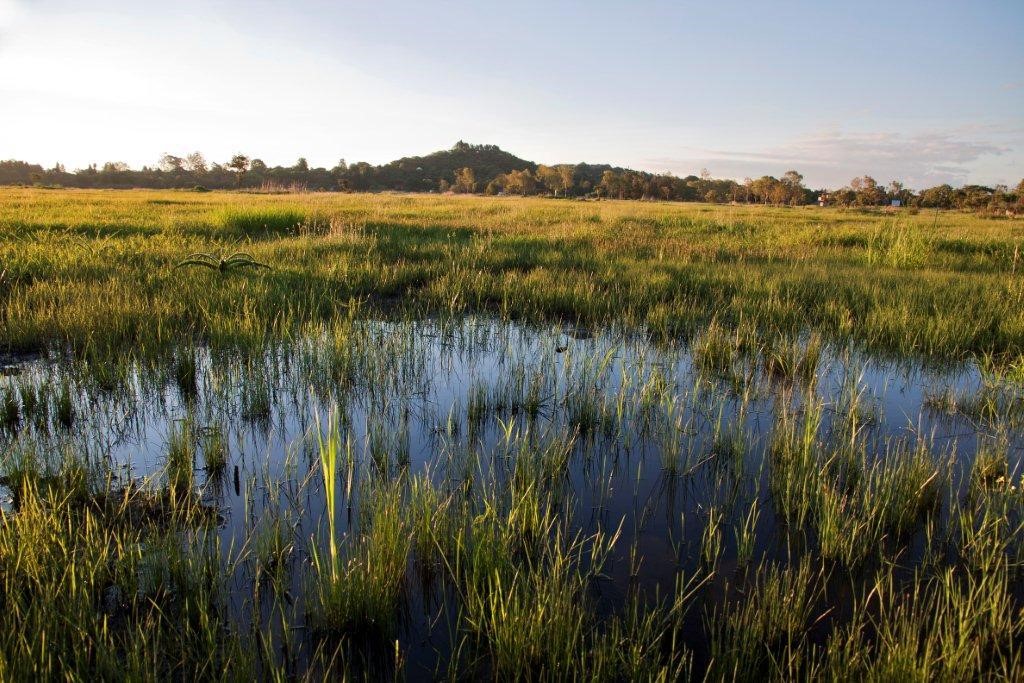
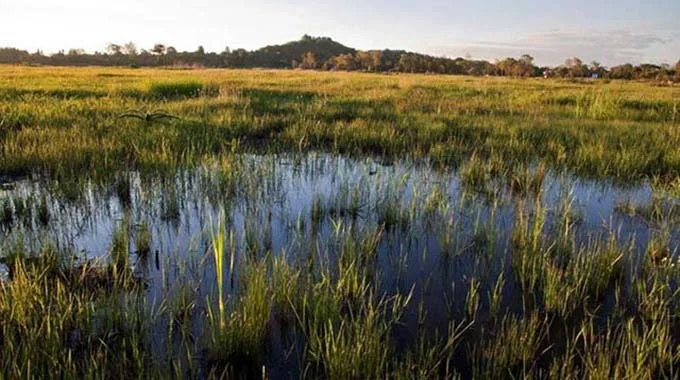
Monavale Vlei in Harare
“We can’t rely on summer rainfall runoff alone,” says Dorothy Wakeling, programme manager of the Conservation Society of Monavale (COSMO) in Harare. “Wetland ecosystems keep streams and rivers flowing year-round, even during dry months and droughts. If we destroy these areas through cultivation, construction, and mining, we are jeopardising our water supply.”
Wakeling emphasises the paradox: “We can’t blame climate change if we destroy the very ecosystems that mitigate its effects. Zimbabwe is a headwater wetland country, where streams originate. If we destroy our headwater wetlands, we have nowhere else to turn for water
From Monavale to Driefontein: conservation in action
Further east, the Driefontein Grasslands, which span parts of Masvingo, Midlands and Mashonaland East provinces, support globally threatened birds, including the wattled crane. The Ramsar site also sustains farming and grazing activities in communal areas, making its future dependent on balancing habitat protection with local needs.
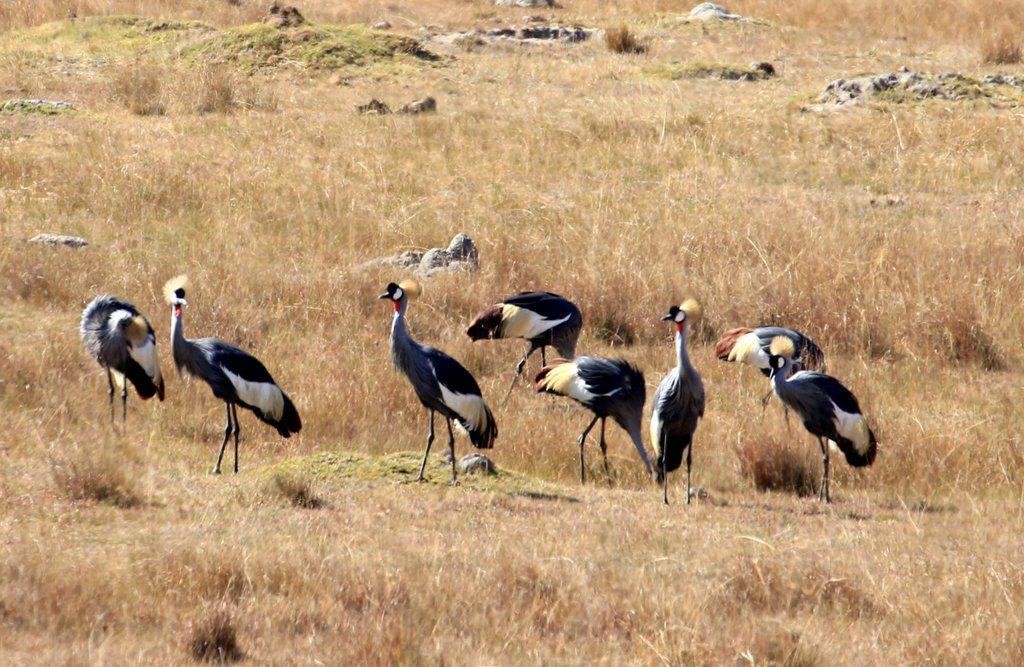
Driefontein Grasslands
Zimbabwe has seven wetlands designated under the Ramsar Convention, covering approximately 453,828 hectares. The sites include urban wetlands, lakes, grasslands and
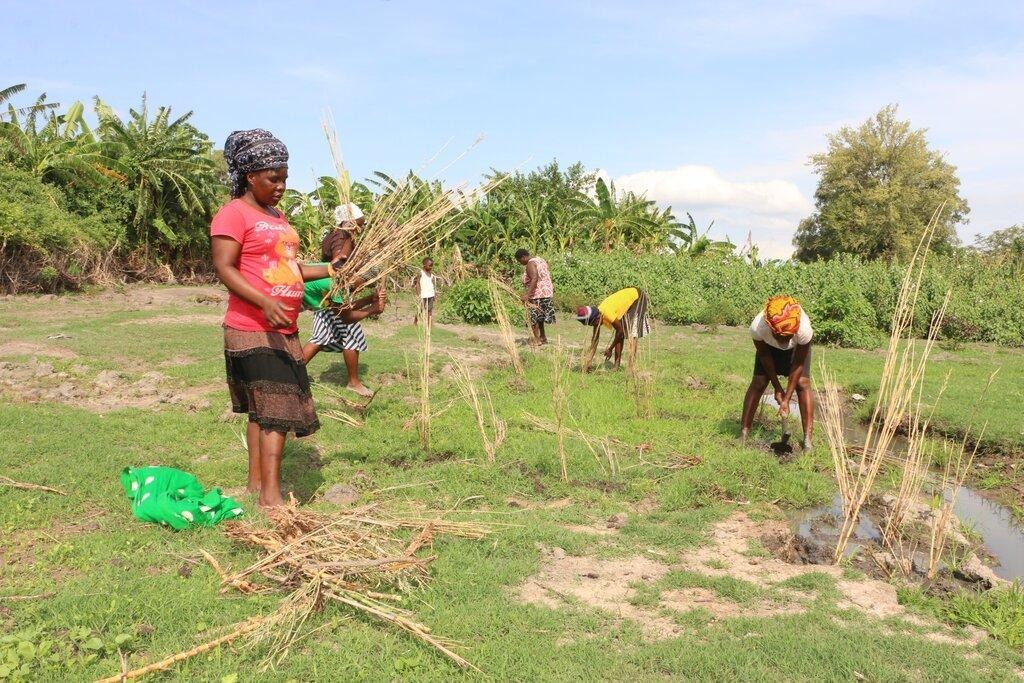
Community participation in wetland conservation at Driefontein.
Their international status recognises their importance, but designation alone cannot prevent encroachment, pollution or unsustainable land use.
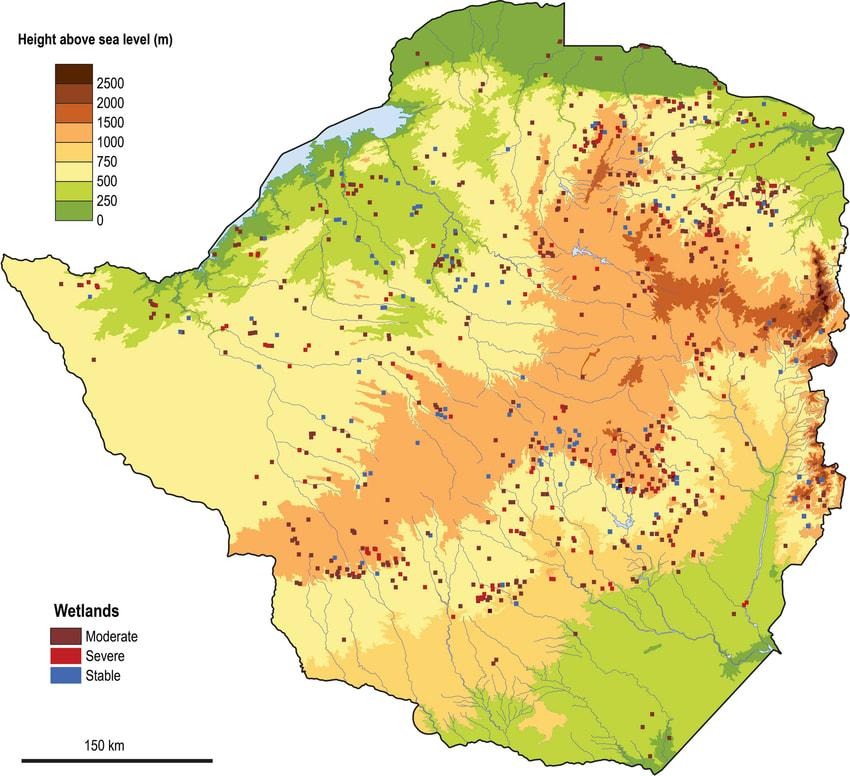
Zimbabwe wetlands map. Source: Researchgate
Dr. Leonard Unganai, a climate expert at Oxfam, an international non-governmental organisation(NGO), attributes much of this degradation to human activity, particularly unchecked urban expansion and agricultural practices.
Laws need to work on the ground
Zimbabwe has a legal framework for wetland protection. Section 73 of the Constitution guarantees the right to an environment that is not harmful to health and well-being, while the Environmental Management Act (Chapter 20:27) provides for wetland protection and regulates activities that can damage these ecosystems.
The National Wetlands Policy also guides sustainable use, protection and restoration. Internationally, Zimbabwe is a party to the Ramsar Convention, which promotes wetland conservation and the wise use of wetlands.
“These guidelines will help regulate activities that threaten our wetlands and ensure effective conservation efforts,” said Aaron Chigona, Environmental Maanagement Agency director general.
Dr. Patrice Talla, Food and Agricuture Organisation (FAO)’s Subregional Coordinator for Southern Africa, says that the FAO supports the Zimbabwe government’s efforts to restore damaged wetlands and promote responsible use.
In July 2025, the country hosted the convention’s 15th Conference of the Contracting Parties in Victoria Falls, placing wetland conservation and sustainable management on the international agenda.
The remaining test is implementation.
Local authorities need accurate wetland maps and development plans that recognise wetlands as essential ecological infrastructure, rather than vacant land available for construction or cultivation. Regulators must assess proposed activities, monitor compliance and act against unauthorised disturbance.
Communities also need sustained technical and financial support. Fencing, water-storage infrastructure, monitoring and environmental education all require resources if restoration is to endure.
Kasibo suggests that conservation works best when communities understand the relationship between a healthy wetland and their own livelihoods. Traditional knowledge can reinforce this approach. Mpofu-Zuze said elders had regarded the area as a place of spiritual significance, a cultural association that helped preserve it.
Combining such knowledge with scientific monitoring can help communities protect wetlands while managing competing demands on water and land.
Measuring what lasts
The Kasibo project demonstrates that environmental protection and rural economic activity need not be opposing goals. A functioning wetland can support food production, income and access to water while maintaining ecological functions.
But its success should not be measured only by the crops harvested, fish raised or money earned. Continued monitoring must establish whether water levels remain stable, vegetation recovers, biodiversity improves and downstream water sources continue to benefit.
Nor should the creation of a productive garden justify unrestricted cultivation inside sensitive wetland areas. The long-term objective is to protect the ecosystem’s natural functions while allowing carefully managed activities around it.
For Ncube and the other women farmers, the stakes are immediate. The garden provides food and income in a region where unreliable rainfall makes farming precarious. For the wider community, the wetland offers a buffer against water shortages.
Its future depends on keeping that balance intact.
Zimbabwe’s wetlands cannot withstand the combined pressures of climate change, poorly planned development and unsustainable resource use indefinitely. Kasibo offers evidence that communities can reverse some of the damage when they protect the source of their water rather than exploit it until it fails.
The enduring measure of success will be whether the wetland continues to hold water, sustain wildlife and support families when the next drought arrives.
“We have the opportunity to turn the tide,” Wakeling says, her voice filled with hope. “If we work together—communities, non-governmental organisations, and the government—we can save our wetlands for ourselves and future generations.”