
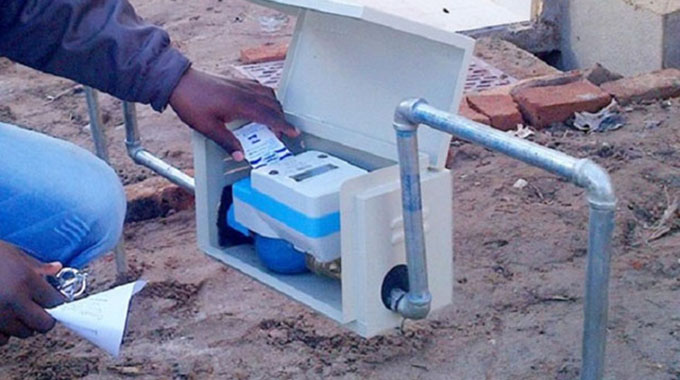
Harare, (New Ziana) – The Zimbabwe National Water Authority (ZINWA) is expanding its prepaid water metering programme to Tsholotsho, Nkayi and Lupane, in a move aimed at giving consumers greater control over their water bills while tackling mounting customer debts that threaten the sustainability of water service delivery.
The rollout signals a continued shift towards a billing system that allows consumers to pay for water in advance, manage their consumption and progressively settle outstanding debts, while enabling the authority to redirect resources towards maintaining critical water infrastructure.
In a press statement, ZINWA Head of Corporate Communications and Marketing, Marjorie Munyonga, said the installations in the three centres fell under the authority’s Gwayi Catchment and formed part of a wider expansion programme.
“The Zimbabwe National Water Authority (ZINWA) has commenced the roll out of prepaid water meters in Tsholotsho, Nkayi and Lupane as part of ongoing efforts to enhance customer convenience and curb a growing debtors’ book,” she said.
The latest installations follow the rollout of the system in Gutu, Nyika, Rutenga, Chirundu and Chivi earlier this year, with the authority planning to extend the programme to more communities across the country.
“The roll out is expected to expand to other towns, growth points and rural service centres where ZINWA provides service,” she added.
The prepaid metering initiative builds on a programme that began with successful pilot projects in Mvurwi and Chivhu in 2020. Since then, ZINWA has installed the meters in several other centres, including Murambinda, Guruve, Murehwa, Mutoko, Nyanga, Hwange, Gokwe, Filabusi, Karoi and Glendale.
At the heart of the initiative is the need to make water billing more predictable for consumers, many of whom can struggle to settle large bills accumulated over a month of consumption.
Under the traditional post-paid system, customers use water before being billed, sometimes leaving them uncertain about the final cost until the bill arrives. The prepaid system, however, allows consumers to determine their water budgets in advance and regulate consumption accordingly.
This gives households and businesses an opportunity to plan their expenditure while reducing the risk of accumulating unsustainable arrears.
“Prepaid water meters also help in establishing transparency and eliminating billing disputes, which are quite common under the post-paid metering system,” Munyonga said.
Importantly, the new system does not automatically require customers with outstanding balances to clear all their arrears before continuing to access water.
Instead, debts accumulated under the previous billing arrangement are transferred to the prepaid account, allowing consumers to continue receiving water while gradually settling their outstanding obligations.
“Debts accrued during the post-paid period are automatically transferred to the prepaid account, allowing water users to enjoy service while progressively clearing their legacy debt,” she said.
The arrangement provides a mechanism for recovering outstanding revenue while giving indebted customers an opportunity to settle their obligations over time.
For ZINWA, the benefits extend beyond revenue collection and billing efficiency to the day-to-day management of water supply infrastructure.
Monthly meter readings under the conventional system require personnel and other operational resources that could otherwise be deployed to address maintenance needs, repair faults and improve distribution networks.
Munyonga said the prepaid system would allow the authority to redirect some of these resources towards essential infrastructure work.
“Prepaid water meters also help utilities to improve service delivery as resources normally deployed to post-paid metering, such as monthly meter readings, will now be used for other purposes such as repairs and maintenance of the water treatment and distribution systems,” she said.
New Ziana